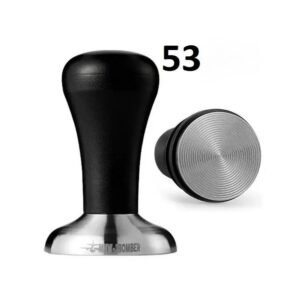
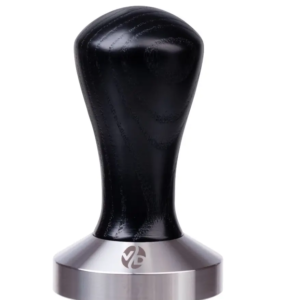
A coffee tamper is a basic barista tool designed to compact ground coffee beans in a portafilter. The standard tamper pressure is approximately 15 kg (30 lbs), which provides the optimal density of the coffee tablet for proper espresso extraction.
Its use is essential for making the perfect espresso.
Coffee that is not evenly compacted over its entire surface can create pores or “channels” in the coffee tablet, through which water will pass too quickly. The result will be poor extraction, an unsaturated and unbalanced taste of the drink.
This phenomenon is called channeling – when water finds the path of least resistance through loose areas of the coffee, leading to under-extraction in some areas and over-extraction in others. The result is an unstable crema, a watery taste and acidity instead of a balanced espresso.
Proper tempering allows the water to be evenly distributed over the entire surface, releasing aromatic oils and flavor compounds. Uniform sealing allows you to get a balanced, without excessive bitterness or wateriness, taste and rich aroma of espresso.
Tempering works in tandem with the correct coffee grind. For espresso, a fine grind (fine/extra fine) is used, which, when properly tempered, creates optimal resistance to the water flow under 9 bar pressure in the espresso machine group.
Types
The choice of temper depends on personal preferences, conditions of use and budget.
They differ in the following parameters: material of manufacture, purpose and design.
Varieties by purpose:
- Standard: Used for both daily home and professional espresso preparation.
- Professional: Often have an adjustable handle for even pressure distribution and additional functions to ensure perfect tempering.
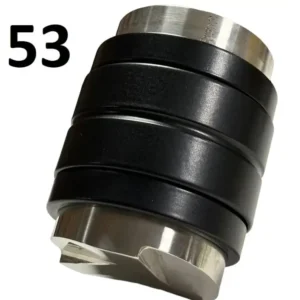
3. Calibrated (with spring): Have a built-in mechanism that automatically limits the pressure at a given level (usually 15-20 kg), ensuring stable tempering regardless of the barista’s pressing force.
4. Push tempers: Automatically create uniform pressure thanks to a built-in spring. Convenient for intensive use in coffee shops.
Classification by manufacturing materials:
- Metal: The most popular models are made of stainless steel, aluminum, or titanium. Stainless steel is the strongest (weight 400-600 g), resistant to corrosion and scratches. Aluminum is lighter (250-350 g), more affordable, but less resistant to damage. Titanium is a premium option that combines the lightness of aluminum with the strength of steel, but costs significantly more.
- Wooden: They have an aesthetic appearance and are pleasant to the touch, but require more delicate care. Suitable for lovers of classics and natural materials.
- Plastic: Lighter and cheaper, but less popular among professionals, since they do not provide such an accurate compaction as metal models. In addition, plastic is easy to scratch.
The design of a coffee tamper includes several important elements: the base and the handle.
The base is the contact, working part of the tool that directly interacts with the coffee in the portafilter. It can be flat, convex, spherical/conical (ripple), or ribbed (rippled).
A flat base provides uniform pressure over the entire surface. Spherical tampers have a curved base, which allows for more precise control over the pressure, especially in the center of the portafilter. Flat tampers are preferred by professionals, although this factor is not critical. The main thing is that the base is perfectly polished.
The tamper handle can be made of different materials: wood, plastic, metal. It is important that it is ergonomic and fits comfortably in the hand, since it is important to control the pressure well when working with the tamper.
Modern professional tampers may have additional elements: a spring mechanism for calibrating the pressure, pressure level indicators or adjustable height to adapt to different doses of coffee. Some models are equipped with an anti-slip coating on the base or handle for better control.
In different regions of the world, the choice of type depends not only on technical requirements, but also on traditions. In Italy, where espresso is the most popular coffee drink, flat bases are preferred, which ensure even pressure distribution.
In the USA and the UK, models with a conical or spherical base are popular.
The base of the temper can have different coatings: chrome (the most popular, corrosion-resistant), titanium (premium, extremely durable) or Teflon/non-stick coating (prevents coffee from sticking to the surface).
In Scandinavian countries, where lighter and more convenient tools are often used, options with a wooden handle are chosen.
In each region, it is important that the tool matches the local coffee traditions and the type of espresso machine.
Modern innovations include push tampers, tabletop models that provide perfectly vertical tempering, and smart tampers with a digital display that shows the applied pressure in real time.
Technical specifications
The technical specifications of the tool determine the efficiency, convenience and durability of the tool. Here are the main parameters that you should pay attention to when choosing a temper for making espresso:
One of the most important factors is diameter. The tamper should match the diameter of the portafilter basket of your espresso machine. Standard sizes are: 49 mm (for compact home machines), 51 mm (La Marzocco, Rancilio Silvia), 53 mm (Breville, Sage), 54 mm (some commercial machines), 58 mm (the most common professional standard for La Marzocco, Nuova Simonelli, Faema). They are suitable for most professional machines. Other sizes are used for some home models or less common professional machines.
It is important that the temper fits tightly into the portafilter to ensure uniform compaction of the coffee and high-quality extraction.
Weight significantly affects the effectiveness of tempering. Heavier specimens, weighing from 300 to 600 grams, allow you to apply the necessary pressure without unnecessary effort, which makes the tempering process more precise.
It is worth paying attention to the ergonomics of the handle. It should be comfortable to hold, then it reduces the strain on the hands during prolonged use.
The materials of manufacture affect the durability and accuracy of the tool. The most popular materials are stainless food-grade steel (the strongest and most accurate, often used for professional models) and aluminum (a lighter option, available for home use). More budget options are also used – wood and plastic. The handle material can be wooden, plastic or metal.
Selection criteria
Choosing the ideal temper depends on several key factors that affect the comfort of the preparation process and the quality of the finished drink.
The diameters of the tempers should match the diameters of the portafilter of your espresso machine. Incompatibility of diameters can lead to uneven tempering and deterioration of the taste of espresso.
Temper material. Metal (especially stainless food-grade steel) provide accuracy, they are durable, wooden are aesthetic, plastic are more affordable.
It is important to choose the optimal tool in terms of weight. A 300-600g tamper will allow you to evenly compact your coffee without excessive effort, while lighter models may be less effective.
Ergonomics. The handle should be comfortable, with a good grip. This allows you to work for a long time without feeling tired.
Budget models can be satisfactory for home use, but for professionals it is better to invest in premium models that provide greater precision and are much easier to use.
Usage technique
Proper tempering involves several steps. First, you need to evenly distribute the ground coffee in the portafilter, using a special distributor (leveler/distributor) or simply by gently tapping the edges of the portafilter.
- Dosing: Pour the exact amount of coffee for espresso (usually 18-20 grams for a double espresso) into the portafilter. Use a coffee scale for accurate dosing.
2. Distribution: Evenly distribute the ground coffee in the portafilter using a special distributor (leveler) or the Weiss Distribution Technique (WDT) technique – loosening the coffee with a thin needle to eliminate lumps.
3. Tempering: Holding the tamper vertically, press the coffee with a pressure of about 15 kg, creating a perfectly flat and dense surface. Some baristas perform a “polishing” – a slight rotation of the tamper to smooth the surface.
4. Cleaning: Remove coffee residue from the edges of the portafilter before installing it in the group.
It is important to temper on a tempering mat to protect the table surface and ensure stability.
The optimal tempering pressure is around 15-20 kg (30-40 lbs). Too little pressure (less than 10 kg) results in a rapid extraction and a watery taste, while too much pressure (more than 25 kg) does not improve the result and only puts unnecessary strain on the barista’s hand.
To check the quality of tempering, you can use the “mirror” technique: after tempering, tilt the portafilter slightly – the surface of the coffee should be absolutely smooth and shiny, like a mirror. You can also use the “tapping” technique: after tempering, lightly tap the edge of the portafilter – if the coffee is compacted correctly, there will be no cracks on the surface.
Common mistakes:
- Uneven tempering – when the pressure is uneven, it can lead to incorrect extraction and spoil the taste of the espresso.
2. Too much or too little pressure – too much pressure can cause water to flow too slowly, and too little pressure can cause extraction to be too fast.
3. Incorrect diameter of the tamper – if it is too big or too small for the portafilter, the finished drink may disappoint you.
4. Tilted tempering – when the tamper is held at an angle, which leads to uneven density of the coffee.
5. Poor distribution before tempering – lumps or cavities in the coffee before tempering cannot be corrected by pressure alone.
Failure to clean the edges of the portafilter – coffee residue on the edges can break the seal and affect the extraction.
Incorrect tempering can significantly complicate the extraction process and spoil the taste. If the coffee is not compacted evenly or not enough pressure is applied, “channels” appear in the coffee tablet, which leads to uneven water flow, which in turn causes underextraction in some areas and oversaturation in others. As a result, the espresso comes out with a poor balance of taste: some may be too bitter, while others are too sour or watery. Improper tempering also impairs the stability of the crema.
To obtain the perfect espresso, it is important not only to temper correctly, but also to use quality espresso coffee with the correct grind. Too fine a grind combined with too much tempering will create excessive resistance to the water, which will lead to overextraction and a bitter taste. Too coarse a grind, even with the correct tempering, will give underextraction and a sour, watery taste.
Properly tamped coffee provides optimal espresso extraction time — 25-30 seconds for a double serving (18-20 g of coffee). Insufficient tempering reduces the time to 15-20 seconds, and excessive tempering increases it to 35-45 seconds, which negatively affects the balance of taste.
Temper and other barista tools
A temper is just one tool in a barista’s arsenal, working in conjunction with other equipment:
Coffee grinder: Ensures the correct grinding of coffee for espresso. Without a quality coffee grinder, even the best temper will not help you get the perfect result.
Distribution tool: Used before tempering to evenly distribute the coffee in the portafilter. Eliminates lumps and creates a flat surface.
Tempering mat: Provides a stable surface for tempering and protects the portafilter and countertop from damage.
Coffee scales: Allow you to accurately dose the coffee (usually 18-20 g for a double espresso), which is critical for a consistent result.
Espresso machine: This is where the magic of extraction takes place – water under 9 bar pressure passes through a perfectly tempered coffee tablet for 25-30 seconds, creating the perfect espresso with a thick crema.
Using these tools in combination allows the barista to fully control the preparation process and get a consistently high result every time.
Care and storage
To ensure durability and efficiency, it is important to clean the temper regularly. After each use, you need to wipe it from coffee residues with a dry or damp cloth. For deeper cleaning, from old coffee oils and dirt, you can use a soap solution and a soft brush. It is important to avoid aggressive care products so as not to damage the material.
It should be stored in a dry place, away from high temperatures and moisture, to avoid corrosion and deformation. It is recommended to store it in a special container or at least on a flat surface to avoid damage, scratches, etc.
With proper care, high-quality tempers can last for many years. Metal ones, made of stainless steel or aluminum, can remain in new condition for decades. Wooden models require more care due to the risk of damage and cracks.
It is important to regularly check the temper for damage and replace it if necessary.
Where to buy a quality temper
In our store you can find high-quality tempers at an affordable price. The managers of the Kyiv City Roastery online store will provide qualified advice. If you have the opportunity to visit our specialized store in Kyiv, the Roastery specialist will not only offer to buy a temper according to your needs, but will also help you check the tool on site. With us you can be sure that you are getting high quality at a reasonable price.
In our assortment you will also find all the accompanying tools for making the perfect espresso: levelers for even distribution of coffee, tempering mats for convenient work, coffee scales for precise dosing, as well as a wide selection of espresso coffees – from classic 100% Arabica to balanced blends with Robusta.
Recommended manufacturers
In our store we offer tempers from two manufacturers: VD Coffee (Ukraine) and MHW-3Bomber (China). These tempers are excellent in use. There are both classic models with a diameter of 58 mm with a smooth base, and more niche options – with a diameter of 51 mm with a grooved base, push-tempers, tempers with a spring.
The price range depends on the material of the product and the manufacturer.
Budget models start at 500.
Professional and premium models with adjustable functions start at 850 UAH and up, depending on quality and design.
The choice should be based on your needs and budget, but remember that investing in a quality tamper can significantly improve the quality of your espresso and, in the end, save money due to its durability.
Popular questions about tampers
How much pressure should you apply when tempering?
The standard pressure is about 15 kg (30 pounds). The main thing is to ensure uniform sealing, not maximum force. Calibrated tampers automatically provide the right pressure.
Do you need a tamper for home use?
Yes, if you use an espresso machine with a portafilter. A tamper is a must-have tool for making quality espresso. Even for home use, it is worth investing in a quality model.
What coffee should you use with a tamper?
The tamper is used exclusively for making espresso with finely ground espresso coffee. It can be 100% Arabica, Arabica blends or blends with Robusta – depending on your taste preferences.
How often do you need to replace the tamper?
A high-quality metal tamper made of stainless steel or aluminum can last for decades with proper care. Replacement is only necessary if the base or handle is damaged.
Can you temper coffee twice?
Not recommended. Repeated tempering can lead to excessive compaction and over-extraction. If the result is unsatisfactory, it is better to start the process over with a new batch of coffee.
What is the difference between a regular and calibrated tamper?
A calibrated tamper has a built-in mechanism that provides the same pressure (typically 15 kg) every time you use it, ensuring consistent results. A conventional tamper relies on the barista’s experience.