The invisible influence of water on taste
Water is not just H2O. It’s a complex mixture of minerals, ions and chemical compounds that dramatically affects the taste of drinks. Two key parameters – water hardness and pH – determine whether your coffee will be bright and balanced, and your tea will be aromatic and full-bodied.
Minerals in water act as invisible architects of flavor. Understanding these parameters allows you to control the quality of beverages at a professional level.
What is water hardness and pH?
pH is defined as a measure of the concentration of hydrogen ions in water. The pH scale is logarithmic from 0 to 14, where pH 7 is neutral. A value below 7 indicates an acidic environment, above 7 – an alkaline environment.
Water hardness is determined by the concentration of dissolved mineral salts, primarily calcium and magnesium salts. TDS (Total Dissolved Solids) measures the total amount of dissolved substances in water.
Chemical nature of water
Calcium ions (Ca2+) and magnesium ions (Mg2+) enter the water as they pass through geological rocks. Calcium hydrogen carbonates Ca(HCO3)2 create temporary hardness. Sulfates and chlorides create permanent hardness.
The norm of total hardness of drinking water in Ukraine is 3-4 mmol/dm³ Source.
| Parameter. | Units | Optimal range |
| pH | – | 6.5-7.5 |
| Stiffness | ppm CaCO3 | 75-175 |
| Mineralization | mg/l | 100-150 |
How water hardness affects the taste of drinks
Water hardness has a dramatic effect on the extraction of flavor compounds. Did you know that minerals act as catalysts for various chemical processes?
Water with calcium promotes the extraction of acids but binds bitter compounds. This creates a balanced flavor profile. Magnesium enhances the extraction of fruit acids, making the flavor brighter.
Soft water versus hard water
Soft water (below 90 ppm) creates a bright, acidic profile. Coffee made with this water has clear fruity notes. But it can appear flat due to over-extraction.
Hard water (above 150 ppm) produces beverages with a fuller body. The acidity is muffled. However, such beverages may have a bitter aftertaste.
- Soft water: brightness, acidity, light body
- Hard water: fullness, softness, muted flavors
The role of pH in flavor formation
pH determines the acid-base balance of water. The scale is logarithmic – water with a pH of 6 is ten times more acidic than water with a pH of 7. This relationship explains why even small changes in pH have a dramatic effect on taste.
Acidic water (pH < 6.5) activates the acid receptors on the tongue. Alkaline water (pH > 8.0) muffles flavor notes, masking delicate aromas.
Optimal pH levels
Coffee requires a pH of 6.5-7.5 for a balanced extraction. Green tea is better at pH 7.0-7.5. Black tea is more tolerant – pH 6.5-7.0.
The Specialty Coffee Association has set standards: pH 6-8 with an optimum of about 7.
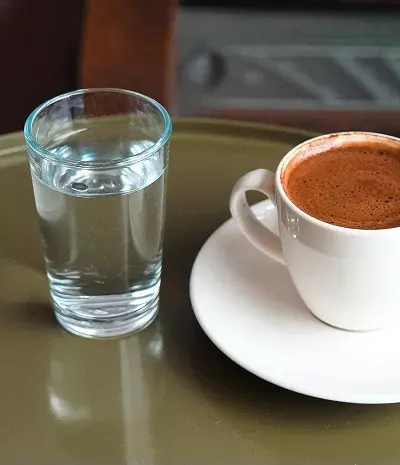
Tea and water: The influence of minerals
Tea is made from 99% water. This makes it extremely sensitive to its mineral composition. Traditional tea masters have always paid special attention to water quality.
Hard water makes tea cloudy and suppresses flavors. Soft water allows you to maximize the flavor compounds. But too soft can make the taste bland.
The optimal hardness for tea is 17-68 ppm. More than 120 ppm makes the drink bland.
Practical tips for improving water quality
Filtration is the first step to improving beverage quality. Reverse osmosis provides complete purification. After RO treatment, water needs to be remineralized.
Home correction methods
Ion exchange filters replace calcium ions with sodium ions. A TDS meter shows the conductivity in ppm. Carbon cartridge pitcher filters remove chlorine.
Control the parameters:
- Use a TDS meter for mineralization
- pH tests for acidity
- Filter tap water
- Experiment with bottled water
Professional approaches
Commercial systems use multi-stage processing. Automatic mixing systems maintain a consistent water profile. Special modules add different mineral profiles for espresso and filter coffee.

Water quality: Impurities
Water contains more than just minerals. Chlorine creates a medical flavor. Iron causes a metallic flavor. Organic impurities add a musty taste.
Filtered water removes most impurities. Bottled water is guaranteed to be free of contaminants. But it may have its own mineral profile.
Conclusions.
Water is a controlled ingredient that has a dramatic impact on the flavor of beverages. Understanding the principles of pH and hardness allows you to achieve professional quality.
Coffee requires a hardness of 50-175 ppm and a pH of 6.5-7.5. Tea prefers softer water with lower mineralization. The buffer capacity ensures flavor stability.
Start by measuring the parameters of your water. This is the first step to improving the taste of your favorite drinks!

Frequently asked questions
What is water hardness and how does it affect the taste of coffee?
Hardness – the content of calcium and magnesium ions. 75-150 ppm is optimal for coffee and ensures a balanced extraction. Too soft makes coffee sour, too hard makes it bitter.
What are the optimal indicators for different types of coffee?
Espresso: hardness 50-100 ppm, pH 6.5-7.5. Filter coffee: hardness 75-150 ppm, pH 6.8-7.2. Alternative methods: hardness 100-175 ppm, pH 7.0. Carbonate hardness 40-75 ppm for all methods.
How to improve water quality at home?
Use a TDS meter to measure mineralization. Install filtration: carbon filters remove chlorine, ion exchange filters soften water. A pitcher filter is enough for basic improvement.
What is pH and how to determine it?
pH is a measure of hydrogen ion concentration, scale 0-14. The value of 7 is neutral, below – acidic, above – alkaline. It is measured with a pH meter (accuracy ±0.01-0.2) or litmus paper (±0.5).
What is a buffer and how does it affect water pH?
The buffer stabilizes the pH when acids or alkalis are added. In water, this role is performed by bicarbonates. The optimal carbonate hardness of 40-75 ppm ensures pH stability during brewing.
How to determine water hardness without instruments?
Watch for scale in the kettle – rapid formation means hard water. Poor foaming of soap also indicates hardness. Flat coffee means soft water, bitter coffee means hard water.