Robusta coffee, what is it?
It is a type of coffee that comes from the Coffea canephora plant. The name “robusta” sounds like “strong”, and for good reason: it emphasizes the plant’s natural resistance to external conditions and high caffeine concentration at the same time. Of all the coffee varieties, it ranks second after Arabica, forming the basis of inexpensive blends and the industrial segment.
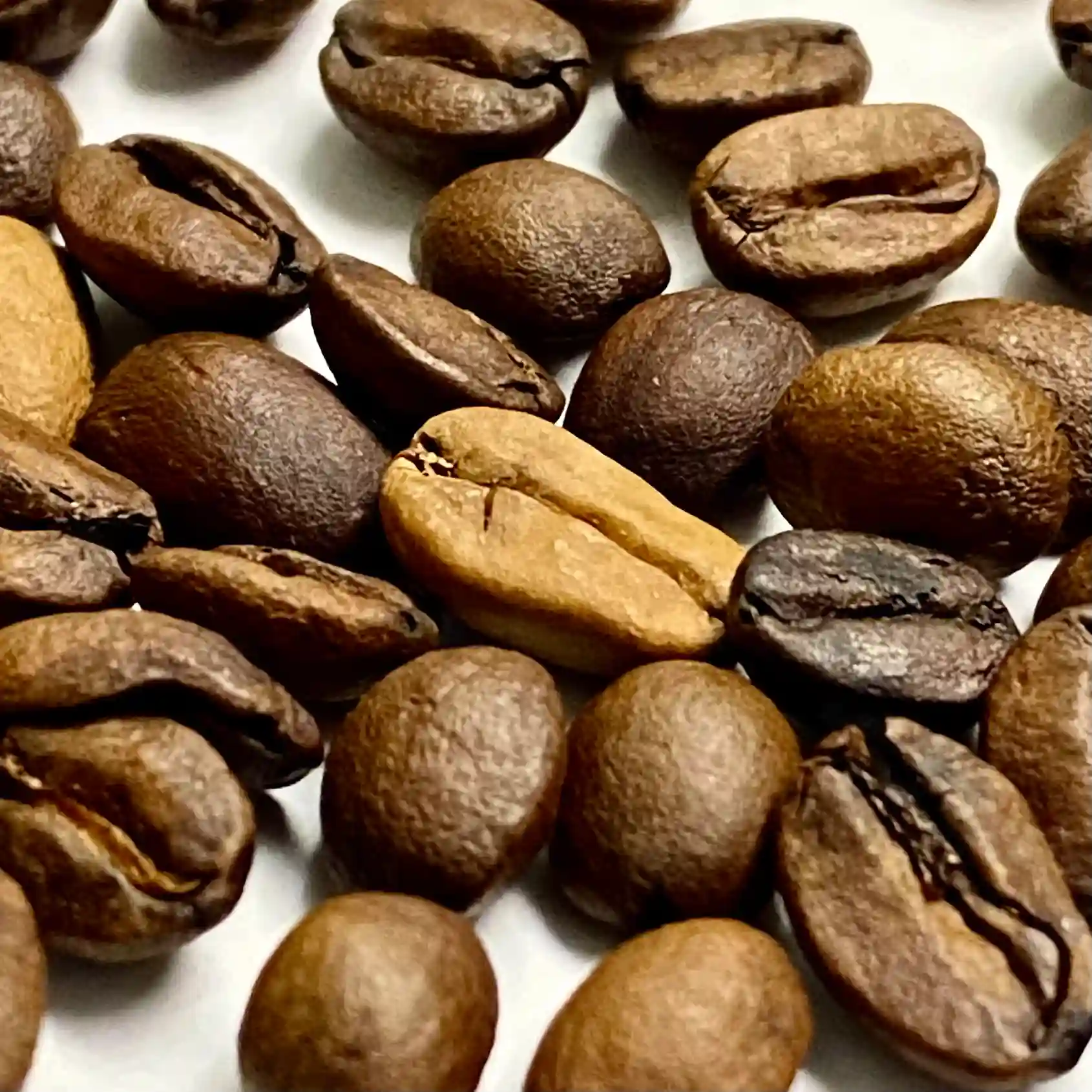
Compared to Arabica, it has a rather sharp flavor, dense body, and pronounced bitterness. Its beans are rounder and contain high levels of caffeine and chlorogenic acids, which give the beans their characteristic astringency.
Botanical characteristics of the plant
Coffea canephora belongs to the Marena family. This evergreen tree grows naturally in the rainforests of Africa and reaches 10-12 meters. On plantations, it is cut to a height that is convenient for harvesting.
The leaves are wide, glossy, dark green, with a dense structure that helps to withstand hot climates. The flowers are small, white, and have a light jasmine scent. The ripe fruits, or coffee berries, are red-burgundy in color and have strong, rounded beans. The root system of the plant is powerful, capable of extracting water and nutrients from even the least fertile soils.
History and spread of coffee in the world
Robusta was first discovered in the 19th century in the Congo Basin. Its natural hardiness quickly made the plant attractive for cultivation. From Africa, the plant spread to Asia and South America, where the first large plantations appeared.
In the 20th century, it became a real salvation for farmers: its resistance to disease and ease of care allowed for rapid scaling of cultivation. Robusta gained a particularly strong position in Vietnam and Indonesia, the world’s leading producers.
Geography of cultivation
Robusta feels best in countries with tropical climates. The leaders in production are Vietnam, Brazil, Uganda, Indonesia and India.
For successful growth, the plant needs air temperatures of at least +20 °C, abundant rainfall and well-drained soils. Unlike Arabica, which prefers high altitudes, Robusta coffee grows well at altitudes of 200 to 800 meters above sea level, and the taste and quality of its beans is determined by the terroir, a set of natural conditions of the area, such as climate, soil fertility, topography and the number of sunny days.
Growing and care technology
Cultivation begins with soil preparation: it is loosened, enriched with organic fertilizers and moisture levels are checked. The young plants are planted in even rows, providing sufficient distance for air circulation.
Plantation care includes regular pruning, watering, fertilizing and weed control. Although robusta is less vulnerable to pests, sometimes there is a need for biological or natural remedies.
Harvesting is done manually or mechanically. Unlike Arabica, Robusta berries ripen at the same time, which simplifies coffee harvesting and reduces production costs.
Processing and handling of robusta grains
Robusta grains are processed using two main methods: wet and dry.
The wet method allows you to control the fermentation and thus influence the purity of the flavor. The dry method, traditional for Africa and Asia, involves drying the berries in the sun. Natural drying adds density and earthy notes to the coffee.
After fermentation, the beans are carefully dried to optimum moisture content, sorted and shipped to the warehouse where they are stored until they are processed. Quality control is important at every stage: from preventing mold during fermentation and drying to calibrating the robusta beans for size before packaging.
Taste characteristics
This variety has a powerful flavor with pronounced bitterness, earthy and woody notes, and sometimes nuances of cocoa or black pepper. The aroma is less sweet compared to
Importantly, the taste largely depends on the degree of roasting: dark roasting intensifies bitterness and adds chocolate hues, while light roasting preserves the natural roughness and acidity of the bean. Compared to Arabica, Robusta beans give a thicker creaminess and a more powerful energy boost.
Chemical composition and nutritional value
Its caffeine content is about twice as high as that of Arabica, making Robusta beans an indispensable ingredient in energy drinks and strong coffee blends. Coffee is rich in antioxidants and chlorogenic acids, which help reduce inflammation and have antimicrobial properties.
The coffee is characterized by a pronounced acidity, bitterness and high caffeine content, which invigorates and tones up. Thanks to this, robusta has a more active effect on the body, increasing tone, concentration and metabolic rate.
Use in the coffee industry
Robusta plays an important role in blending, enhancing the density and strength of blends and contributing to the formation of a thick cream in espresso. It is the basis for most types of instant coffee due to its high soluble solids yield.
In addition, due to its high caffeine content, it is used in the food and cosmetics industry.

Advantages and disadvantages of growing
The main advantages of robusta are disease resistance, high yields and low requirements for growing conditions. This makes it economically viable for farmers.
However, the environmental impact of intensive plantations can be negative if sustainable practices are not implemented. The conditional disadvantages include a more modest flavor palette than that of Arabica.
Current trends and the future of robusta
Breeders are working on new coffee varieties with a more delicate profile and improved sweetness. Fermentation technologies make it possible to produce coffee with fruity and caramel notes.
Consumers are gradually changing their attitudes toward robusta, discovering its potential. Due to climate change, robusta can partially compensate for the global loss of arabica harvests, as it is better adapted to excessive sun and moisture.
Tips for selection and consumption
Quality robusta is easy to recognize: a round, dense bean with a straight groove, smooth and clean, without the smell of mold or impurities. An espresso machine, geyser coffee maker, and French press are suitable for preparation.
Dark roasting emphasizes its character, and combining it with milk or cocoa softens the bitterness. In blends, this variety balances Arabica and completes the drink with a velvety creaminess.