The formula for perfect milk foam: how physics and technology create the perfect texture
Many people perceive milk foam in coffee drinks as a decorative element. However, milk frothing affects the texture and flavor of the drink.
The ideal microfoam is based on a whole set of physical and chemical processes: the interaction of milk proteins with air, temperature control, and the right pressure and humidity of the steam.
Let’s look at how this system works from a scientific point of view.

Physics of foam and bubbles
Milk foam is a colloidal system in which millions of microscopic air bubbles are held in a liquid. Protein molecules play a major role in stabilizing this structure.
At the molecular level, a bubble is air surrounded by a thin film of liquid. In ordinary water, such bubbles collapse quickly due to surface tension. In milk, however, proteins (mainly casein and whey proteins) are able to partially unfold and create a stable shell around the bubble.
As the nozzle works, the steam helps to saturate the milk with air, forming micro-foam. The proteins are attached where the air comes into contact with the liquid, reducing surface tension and stabilizing the bubbles. This is how a fine, uniform and silky structure – microfoam – is formed.
Optimal parameters for giving milk a foamy structure
The quality of the foam depends largely on the characteristics of the steam, the most important of which are temperature and pressure.
For professional espresso machines, the optimal parameters are usually:
– steam temperature: approx. 120-130 °C
– steam pressure: 1.0-1.5 bar
With these parameters, the milk heats up quickly and air is evenly integrated into its structure. If the steam temperature is too low, foaming slows down and the structure becomes less homogeneous. Too high a temperature, on the other hand, can overheat the milk and destroy protein structures, causing the foam to become unstable or not form at all.

Effect of humidity on foam texture
The amount of water in the steam directly affects the quality of the milk foam. Steam can be dry or wet.
Dry, respectively, contains a minimum of water droplets. It quickly transfers heat to the milk and effectively introduces air.
Advantages of dry steam:
- fast formation of microfoam;
- homogeneous velvety texture;
- easy control of the execution stages.
Moisture contains more water droplets, some of whose energy is used to heat them instead of forming bubbles. This can lead to:
- large and unstable bubbles;
- less uniform texture;
- liquid, less creamy foam.
For professional milk aeration, dry steam is usually used, and controlling its humidity level allows you to get perfectly uniform microfoam.
Steam pressure and its impact on milk froth creation
The steam pressure determines how much air and heat are introduced into the milk.
High pressure accelerates frothing: the milk heats up faster and the air is introduced more actively. At the same time, high pressure can lead to the formation of large bubbles and makes it more difficult to control the formation of the foam texture.
The low pressure ensures a slower and more controlled process. It takes more time to heat the milk, but it is optimal for learning the technique if you are a beginner and for working with alternative types of milk. Home coffee machines mostly work in this pressure range, which allows you to create a uniform and stable micro-foam without rushing.

The role of the nozzle in creating high-quality foam
Regardless of the pressure level, proper immersion of the nozzle, the steam tube, is important to obtain a homogeneous and stable foam.
The result is influenced by the angle of the nozzle, the immersion depth, and the diameter of the nozzle orifice.
The slight tilt creates a rotational movement of the milk, the so-called vortex. This movement distributes the bubbles evenly and gradually forms micro-foam.
Multi-hole nozzles generate a more powerful flow that accelerates whipping, while single-hole nozzles provide a smoother flow and allow for better control of the foam texture.
Milk temperature
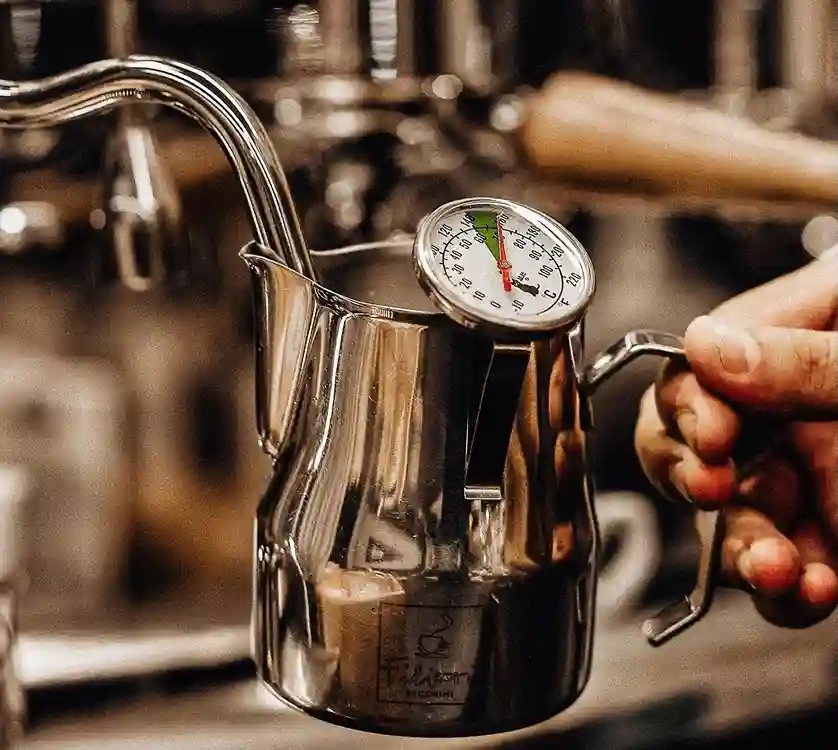
Cold milk retains air better, so it needs to be cooled before use. When heated to 30-40 °C, aeration begins: air is actively introduced and bubbles form. At 40-60 °C, the bubbles become small and evenly distributed, creating a smooth structure. Stabilization occurs at a temperature of 60-65 °C. In milk heated to more than 70 °C, proteins begin to break down, making it impossible to create a stable microfoam.

Stages and techniques for creating milk microfoam
The classic technique for creating smooth and shiny microfoam consists of several steps.
- Pour cold milk into the pitcher.
- Immerse the nozzle just below the surface and wait for a slight hiss, which indicates the introduction of air into the milk.
- After aeration, lower the nozzle deeper to create a vortex.
- Continue heating the milk to 60-65 °C.
- At the final stage, the pitcher with milk is tapped lightly and gently swirled to even out the texture.
Common mistakes
A number of mistakes affect the quality of the foam: excessive aeration, which leads to large bubbles; overheating of the milk, which destroys protein structures; incorrect nozzle immersion angle, which does not form a vortex and the foam becomes heterogeneous; and too deep immersion at the beginning, when no air is introduced and the milk is only heated.
Assessment of milk foam quality
Professional baristas evaluate foam according to several criteria:
- texture – small uniform bubbles
- stability – the foam does not delaminate
- gloss – the surface looks silky
- taste – sweet and creamy
High-quality microfoam should resemble thick cream.
Practical recommendations for different types of milk
Whole milk is best for creating a creamy texture due to its high fat content. Skim milk does not produce a thick and stable foam.
Vegetable milk, such as almond, soy, banana, and oat milk, requires adaptation of the technique: a lower steam temperature and a short aeration stage.
Modern baristas are actively experimenting with different parameters to achieve a stable, smooth microfoam even when using alternative types of milk.