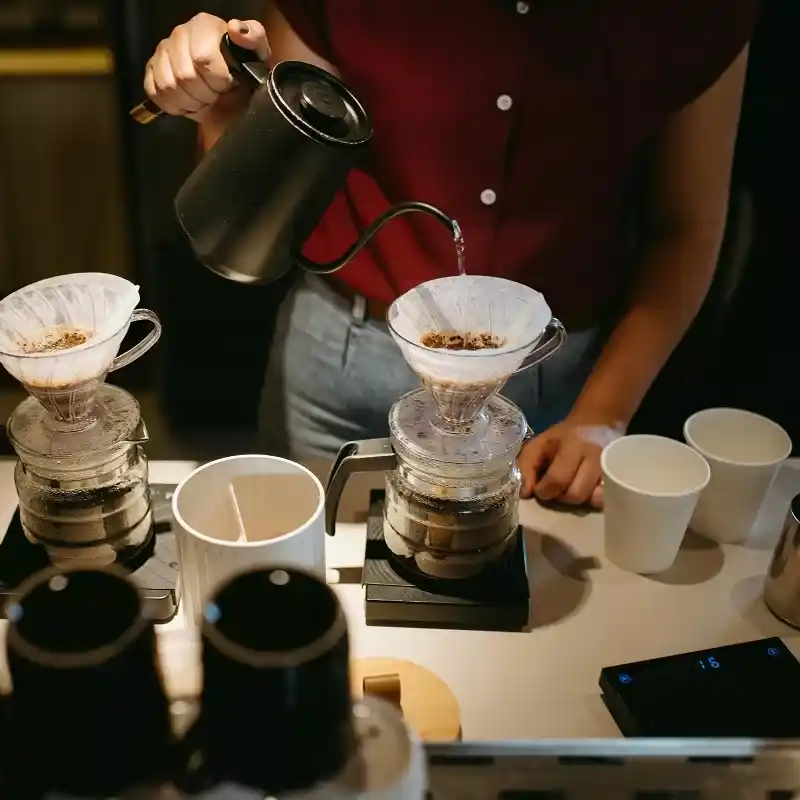
The beginning of the story: From laboratory glass to coffee equipment
In 1921, a small workshop was opened in the Kanda-Sudacho district of Tokyo. The founder Hiromu Shibata dreamed of becoming the “king of glass” in Japan. Could he have imagined that a century later his company would change the way coffee is brewed around the world?
Hiromu Shibata Works specialized in the production of laboratory glassware made of heat-resistant glass. Each product reflected traditional Japanese attention to detail. Craftsmen worked with mathematical precision to create flasks and test tubes for scientific laboratories.
Heat-resistant glass was a revolutionary material of that era. Unlike ordinary glass, it could withstand high temperatures without deformation. This technology would later become the basis for coffee equipment.
Precision engineering has always defined the company’s approach. Every millimeter mattered in the laboratory equipment. The principles of thermodynamics used in scientific glassware proved to be ideal for coffee extraction.
The journey from laboratory flasks to coffee funnels took decades. But the logic was clear: scientific precision could improve the daily ritual of millions of people.
Founding and early years of Shibata Works
Japan in the 1920s was undergoing a period of modernization after World War I. Hiromu Shibata saw an opportunity in the growing demand for high-quality laboratory equipment. His workshop began by producing simple flasks and test tubes.
The traditional Japanese philosophy of excellence was combined with modern technologies. Each product was subjected to rigorous quality control. The craftsmen rejected products with the slightest defects – reputation was more important than profit.
For the first decades, the company focused exclusively on scientific glass. Chemical laboratories, universities, and research centers all needed reliable equipment. The experience of working with precise parameters has become invaluable.
The 1950s saw the first experiments with household products. Understanding the behavior of glass at different temperatures offered a unique advantage. This expertise would soon open the door to the world of coffee.
First attempts: Hario’s experiments in the world of coffee (1960-1980)
Coffee siphons were Hario’s first step into a new industry. In 1949, the company launched a glass siphon, and in 1957, a model with a fabric filter. The Japanese fell in love with the theatricality of the brewing process in siphons.
But engineers dreamed of something simpler. In the 1950s, the development of the V60 prototype began, although commercial success was still far away. The power brewing method was just emerging as an alternative to complex methods.
In 1980, the Mini Coffee Dripper appeared – a direct ancestor of the future V60. The cone shape was already there, but it lacked key innovations. The engineers realized that something more was needed.
Experimentation with the parabolic shape had been going on for years. The goal was ambitious – to create a cleaner cup of coffee through optimized water flow. Each unsuccessful prototype provided new insights into hydrodynamics.
These “failures” were actually an investment in the future. Decades of research had accumulated an understanding of extraction. Hario V60 was born gradually, step by step.
Birth of the V60: Revolutionary design for 2004
The year 2004 changed the history of coffee forever. Hario introduced a design that seemed simple but hid years of engineering calculations. The V60 was not just another funnel – it was a breakthrough in the understanding of extraction.
Why exactly 60 degrees? Engineers tested dozens of angles. Too sharp – water flows too fast. Too blunt – it stagnates. 60 degrees turned out to be the perfect balance between speed and contact.
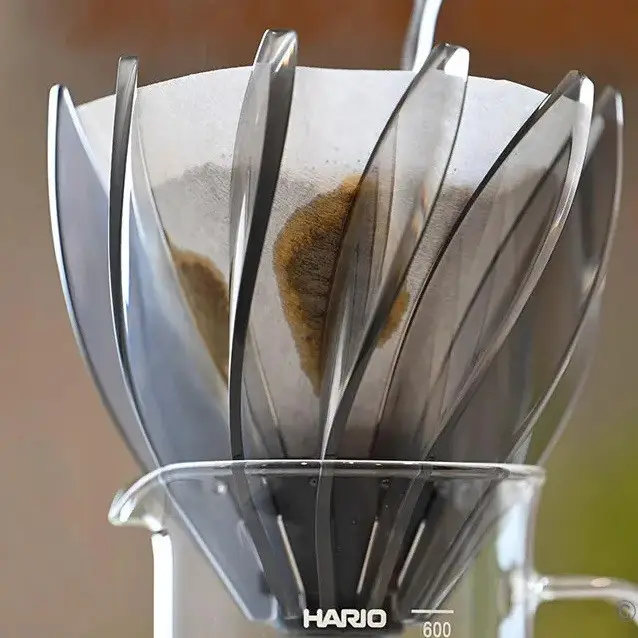
The spiral fins are a true design innovation. Positioned at precise angles, they create air channels between the filter and the walls. This prevents sticking and ensures an even flow – brilliantly simple!
The large opening at the bottom gives the barista full control. Unlike drippers with several small holes, the V60 allows you to adjust the extraction by the pouring speed. Want a longer extraction? Pour slower. Want a shorter extraction? Speed up the rate.
Precision engineering is evident in every millimeter. The wall thickness, the radius of the ribs, the diameter of the hole – everything is calculated mathematically. Development lasted several years, and in 2005 the V60 finally went on sale.
Anatomy of perfection: Technical features of the V60 design
The 60-degree cone creates the perfect trajectory for the water. It moves downward in a spiral, evenly wetting all the coffee particles. Gravity and geometry work together to create a natural vortex.
The spiral fins are more than just a decorative feature. They direct the water in a spiral path and form channels between the filter and the funnel, allowing air to escape from the bottom. Without this, the filter would stick to the walls, creating “dead zones” with poor extraction.
A large hole with a diameter of about a centimeter is the key to control. The flow rate depends solely on the barista’s technique. It’s like playing a musical instrument – you control every note.
The power brewing method achieves maximum efficiency through the synergy of all elements. Water flows through the coffee under the influence of gravity, but its path is completely determined by the design. The result? A clean, balanced cup without excessive bitterness.
Japanese craftsmanship has turned a simple principle into a perfect tool. Each element has its own function, and they all work as a whole.
| Design element | Function. | Effect on extraction |
| 60° cone | Flow direction | Uniform wetting |
| Spiral ribs | Air ducts | Preventing stagnation |
| Large opening | Speed control | Adjustment of contact time |
Materials and variations: The evolution of the V60 over the years
Heat-resistant glass remains a classic – it retains heat and allows you to observe the magic of extraction. Seeing coffee “bloom” during blooming is almost a meditative experience.
Ceramic versions provide the best thermal insulation of all materials. Arita Yaki-style models are especially valued, which are made of traditional Japanese ceramics. They hold their temperature longer, which is important for stable extraction.
The plastic V60 has become an unexpected hit among professionals. Lightweight, durable, and affordable, they are ideal for travel and competition. Don’t believe me? Many champions choose plastic!
Metal versions, especially copper, have unique thermal conductivity properties. Copper heats up quickly and distributes heat evenly. But this requires adaptation of the technique – extraction is faster.
Three basic sizes cover all needs: 01 for a lonely morning coffee, 02 for a couple or small group, 03 for a large gathering. Each size is optimized for a different amount of coffee.
- Glass: Visual control, classic look / Fragility
- Ceramics: Best heat retention / Weight
- Plastic: Lightweight, durable / Less thermal insulation
- Metal: Fast heating / Requires adaptation of the technique
A variety of colors and limited editions
V60 has become a collector’s item. Classic white, elegant black, bright red, sunny yellow – each color adds to the mood of the morning ritual.
The specialty coffee movement has taken up the idea of the V60 as an aesthetic object. Coffee enthusiasts collect different versions, creating real collections. It is no longer just a tool – it is an expression of personal style.
Limited editions are often sought after. The copper series is especially popular among professionals. The olive wood versions combine natural materials with precision engineering.
Some collector’s models increase in value. This is an investment not only in the quality of the coffee, but also in an item that may become rare. Who knows, maybe your V60 will become a museum piece in years to come?
The V60 in the world of professional coffee
The World Brewers Cup has become an arena where the V60 has proven its superiority. Since 2010, the funnel has been a regular feature at the competition. Six winners between 2011 and 2021 chose it.
The statistics are impressive: from 2011 to 2017, the V60 won five out of seven championships. Tetsu Kasuya (2016), Chad Wang (2017), Odd-Steynar Tollefsen (2015) – these names are forever associated with the V60.
Why do professionals choose it? Versatility and control. Automatic machines dictate their own rules. But the V60 gives you the freedom to adapt each parameter to a specific grain.
The specialty coffee movement has found the perfect tool in the V60. The pure flavor profile reveals the unique notes of each variety. For expensive microlots, this is critical – every nuance counts.
The success came quickly – just five years after the commercial launch. This confirms the correctness of the engineering solutions. The V60 is not just popular – it is efficient at the highest level.
Great baristas and their brewing methods in V60
Scott Rao developed a technique that changed the approach to the V60. His “Rao spin” – the rotation of the funnel to eliminate drainage – has become the standard. 20 – 22 grams of coffee, 330 – 360 ml of water at 97°C, 4:00 – 4:30 minutes – every enthusiast knows these parameters.
Tetsu Kasuya revolutionized the approach with his 4:6 method. The first 40% of water controls sweetness and acidity. The last 60% controls strength and balance. Brilliantly simple!
Each master adapts the basic principles to his own style. The power brewing method gives you this freedom. It’s like jazz – there is a basic melody, but everyone plays in their own way.
Scott Rao has become a legend in the coffee world. Thousands of baristas copy his aggressive blooming and gentle follow-through. The influence of one master on the whole industry is the power of the individual.
- Rao’s method: Aggressive blooming, Rao spin, precise timing
- Method 4:6: Separation into phases, control of flavor profile
- Common: Attention to detail, consistency, adaptation to the grain
V60’s impact on specialty coffee culture
The V60 has made professional brewing accessible to everyone. Previously, high-quality coffee was associated with expensive machines. Now a $20 funnel and a little practice are enough.
The specialty coffee movement has found its symbol. The V60 embodies the core values: quality, origin, and proper processing. The simplicity of the design emphasizes the complexity of the taste – this is philosophy in action.
Baristas have become teachers. Master classes, YouTube channels, Instagram stories – knowledge spreads at the speed of light. Professionals are setting new standards, and consumers are picking them up.
Home brewing has turned into a meditation. In the morning, you’re not just making coffee – you’re creating a moment of peace. The V60 gives you the opportunity to stop, focus, and enjoy the process.
The coffee community has united around a common passion. Discussions of new techniques never cease on the forums. People share recipes like chefs. V60 has become a catalyst for this cultural revolution.
How to make the perfect coffee in Hario V60: An expert’s method
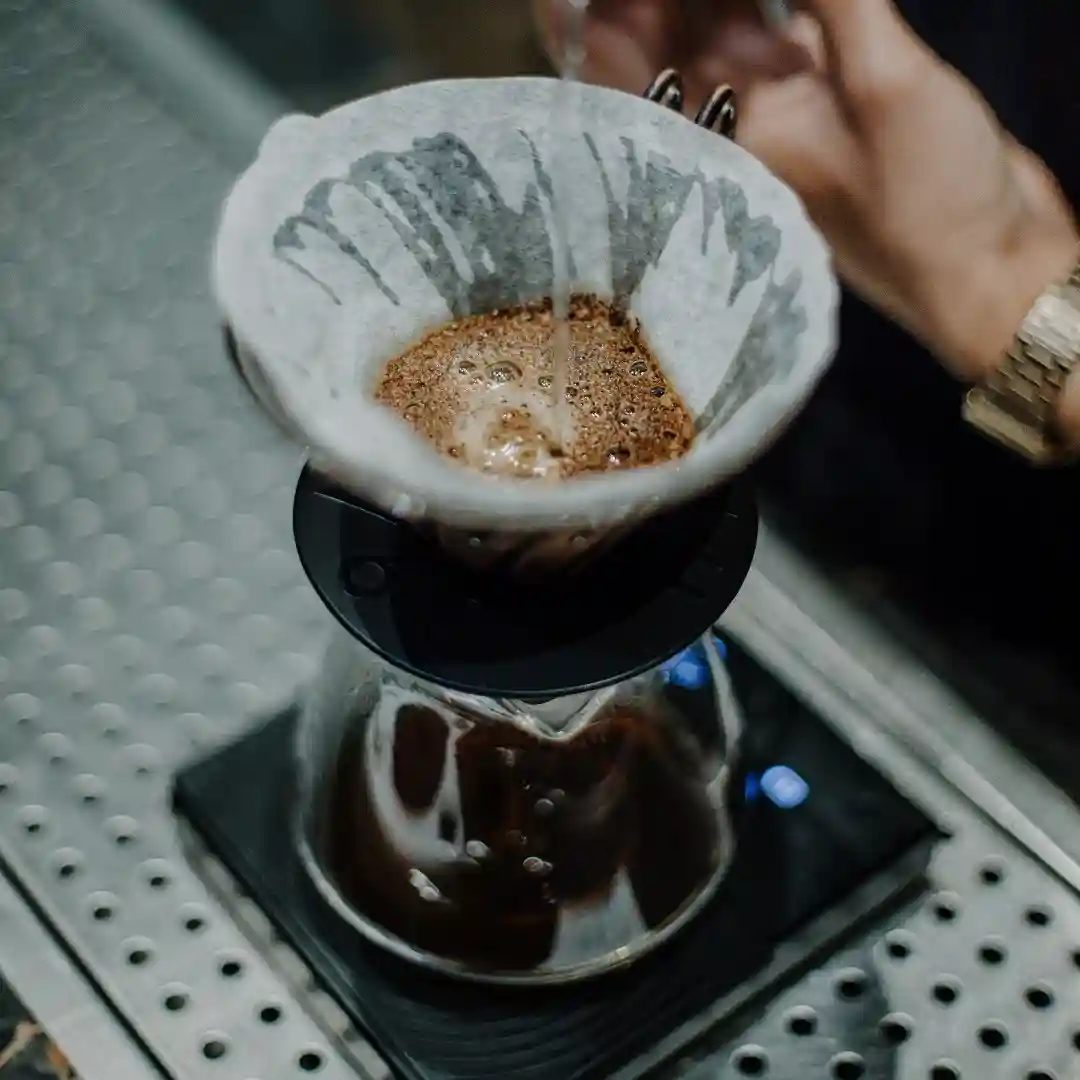
Proper brewing starts with preparation. Place the V60 on the server, insert the filter, and rinse with hot water. This removes the paper taste from the filter and warms up the dishes – don’t skip this step!
The dosage matters: 17-18 grams of coffee per 250-300 ml of water. A grind that looks like sea salt is your guide. Too fine? You will get a bitter over-extraction. Too coarse? The coffee will be weak and sour.
- Preparation (0:00) – Grind coffee, heat water to 92-96°C, rinse the filter
- Blooming (0:00-0:45) – Pour water twice the weight of the coffee, let it “bloom”
- Main infusion (0:45-2:30) – Bring to full volume in circular motions
- Completion (2:30-4:00) – Wait until the flow is complete
The V60’s conical shape works for you. The spiral ribs create the perfect flow. The large opening gives you control – you are the conductor of this coffee symphony.
Temperature is critical. Water that is too hot (over 96°C) will bring out the bitterness. Too cold (below 90°C) will leave acidity. Pouring speed is also important – experiment!
The secret to success? Consistency. Use a scale with a timer. Write down the results. Each variety is unique, but the basic principles always work. Hario V60 is known for its predictability – once you master the technique, you will get a consistent result.
Selecting the right grinding for the V60
Grinding for the V60 is an art of balance. A medium grind, similar to sea salt, provides optimal extraction in 3-4 minutes. But this is only the starting point.
Too fine a grind creates resistance to water. It flows slowly, extracting excessive tannins. The result? Bitter coffee that stings the mouth. The brewing time stretches to 6-7 minutes, which is already too much.
Coarse grinding allows water to pass through too quickly. It does not have time to extract the flavors. The result is sour, watery coffee without body. If the brewing is over in 2 minutes, the grind is too coarse.
Light roasts often require finer grinding. Their dense structure requires more time for extraction. Darker roasts, on the other hand, are best ground coarser – they release flavor more easily.
The pour-over brewing method gives you the freedom to experiment. Is the coffee too bitter? Make the grind coarser. Too sour? Make it a little finer. Write down the settings for each type of coffee – this is your personal knowledge base.
Conclusion: The legacy and future of the Hario V60
Hario V60 is more than just a funnel. It is a symbol of how Japanese craftsmanship can change global culture. From laboratory glass to millions of kitchens – what a journey!
Precision engineering has created a product that does not need to be improved. The basic design has remained unchanged since 2004. Why change something that works perfectly?
The specialty coffee movement received a tool that democratized quality. Professional techniques became available to everyone. This changed not only the way coffee was made, but also the way people viewed it.
The global reach of the V6 is impressive. From Ethiopia to Norway, from Japan to Brazil, the V60 unites coffee lovers. The recognition of professionals confirms that this is not a fashion, but a quality standard.
The future of the V60 looks stable. The innovations are in materials and accessories, but the heart of the design remains the same. Sometimes perfection doesn’t need to be changed – just recognized.
Where to buy the original Hario V60 in Ukraine
Kyiv City Roastery offers a full range of original Hario V60 funnels – from classic ceramic to glass and metal variations. All models can be found here.
How to recognize the original?
A genuine V60 has clear V60 markings on the sides of the funnel and official product codes. Counterfeits are identified by inaccurate rib proportions, incorrect angle of inclination (should be exactly 60°), and poor quality materials.
What to buy with the funnel?
For a perfect brew, you will need:
- V60 server with a volume of 360-600 ml (depending on the number of servings )
- V60 paper filters size 02 – the most popular format
- Measuring spoon or scale for precise coffee dosing
- Kettle with thin spout for controlled pouring
In the Kyiv City Roastery you will find not only funnels, but also all the necessary accessories for alternative brewing. Original Hario products guarantee correct extraction and consistent results in every cup.
Why should you avoid fakes?
Copies from Chinese marketplaces may be 200-300 UAH cheaper, but the incorrect geometry of the ribs and the angle of the funnel ruin the entire brewing process. You won’t be able to control the speed of the water flow, which is the basis of the V60 method.
Frequently asked questions
Who created Hario V60?
V60 was created by the Japanese company Hario Co., Ltd. founded in 1921 under the name Hiromu Shibata Works. Before entering the coffee industry, the company specialized in the production of heat-resistant laboratory glass.
Why is the V60 called this way?
The name comes from the V-shaped cone shape with a 60-degree angle. This angle ensures optimum water flow through the coffee and even extraction.
What are the different sizes of Hario V60?
Three sizes: 01 (1-2 cups), 02 (1-4 cups), 03 (1-6 cups). Each one is optimized for the right amount of coffee with the right surface to volume ratio.
How did the materials of Hario V60 production change?
First glass, then ceramics, plastic, and metal. Each material affects thermal insulation: ceramics retains heat better, plastic is lighter, and metal heats up quickly.
What are the advantages of Hario V60 compared to other methods?
Advantages: full control of extraction, pure flavor profile, 3-4 minutes speed, affordability, ability to experiment with parameters.
What are the disadvantages of Hario V60?
Disadvantages: requires skills and practice, dependence on the quality of grinding, need for additional equipment (scales, kettle goose), sensitivity to errors.
How to choose the right Hario V60 for your home?
For beginners: size 02 made of plastic or ceramic. Take into account the number of cups, budget, experience, and availability of equipment (scales, kettle goose).