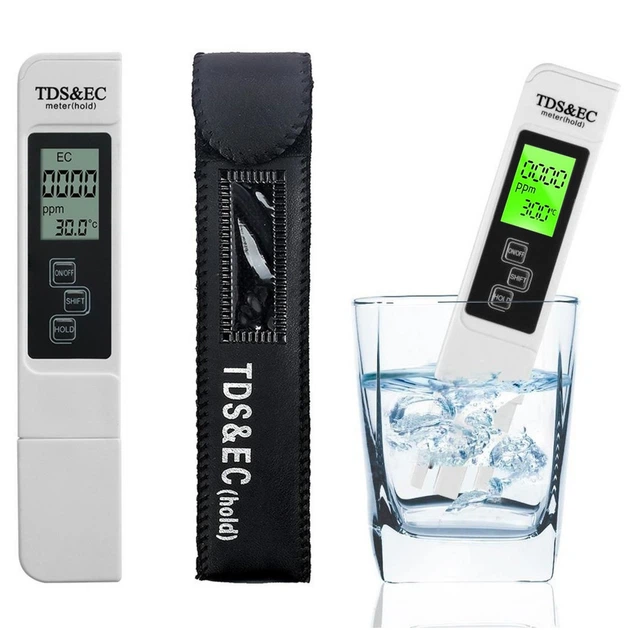
A TDS meter is a small device for monitoring water quality. It is used in coffee shops, aquariums, drinking water production facilities, and at home.
About the TDS meter and how it works
The abbreviation TDS stands for Total Dissolved Solids. Translated from English, this is the total amount of solids dissolved in water. It refers primarily to mineral salts: calcium, magnesium, sodium, potassium, bicarbonates, sulfates, chlorides TDS is measured in ppm (parts per million), which is equivalent to mg/l for drinking water.
TDS meters do not directly track minerals. It measures the electrical conductivity of water. The more ions there are in the water, the easier it is for an electric current to flow through it. The device sends a weak electrical signal between two electrodes and records the resistance of the medium. The resulting conductivity value is converted to ppm using a coefficient.
The relationship between water salinity and ppm is direct, but not absolute: different ions have different conductivities. TDS shows how many dissolved substances are in the water, but does not indicate what kind of substances they are.
The main parameters measured by the TDS meter
The main indicator is the concentration of dissolved salts and minerals. Water with low TDS (e.g., after reverse osmosis) has a minimal amount of ions. Water with high TDS can be either naturally mineralized or contaminated.
TDS is closely related to the concept of salinity. Salinity reflects the concentration of dissolved salts in water and is closely related to TDS. In seawater, the values reach tens of thousands of ppm. In domestic conditions, the average figures range from 50-500 ppm.
Electrical conductivity (EC) remains the basis of measurement. Some instruments allow you to switch between TDS and EC modes to get a more versatile picture for technical applications. EC gives a more accurate picture of the number of ions, useful in laboratories or industry.
Types of devices for water quality analysis
In addition to compact and easy-to-use TDS meters, other instruments are used to analyze water quality.
Salinometers and conductometers – accurately measure salinity or electrical conductivity without conversion to ppm. They are often used in laboratories and in production.
pH meters measure acidity, and ORP meters measure redox potential. These indicators do not show the level of minerals or salts, but they have a significant impact on water quality.
The most affordable option for home use is test strips, which allow you to assess the general condition without numerical values.
Differences between budget and professional devices
The error of budget TDS meters is ±2-5%. Premium models have automatic temperature compensation, replaceable electrodes, a measurement saving function, and the ability to fine-tune conversion factors.
An important aspect is the calibration of devices, in particular according to Standard 442, a special solution of a mixture of salts (sodium sulfate, bicarbonate, and chloride) in certain proportions. This standard better reproduces the composition of drinking water than calibration with NaCl solution alone.
Features of measurement at home
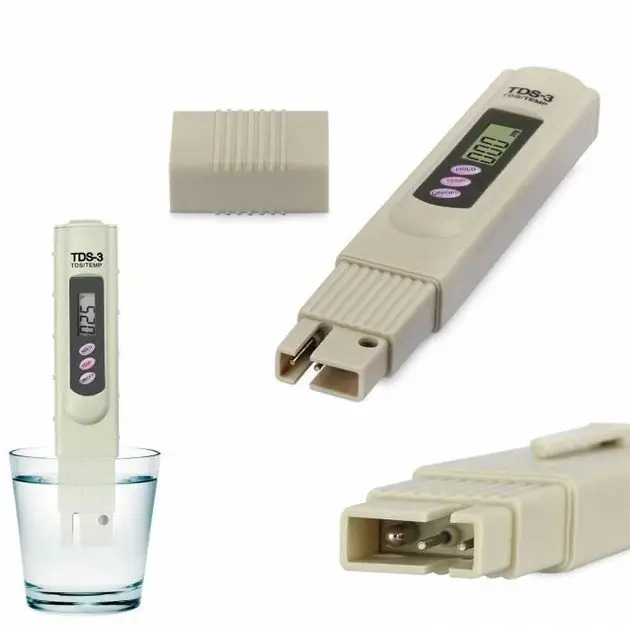
The measurement technique is very simple and easy to follow even at home. It is important that the electrodes are clean, the water is at room temperature, and the immersion is strictly to the mark. Carbonated water, as well as the presence of detergent residues, greatly distort the result. And different types of water (tap water, bottled water, filtered water) can have excellent stability of results.
Do not measure hot water. A high TDS reading is often mistakenly interpreted as contamination. In fact, it only reflects the concentration of dissolved salts and does not always indicate its quality.
TDS after the reverse osmosis system
A reverse osmosis system typically reduces TDS by 90-98%. If tap water has 250 ppm, you can expect 5-20 ppm after the membrane.
Elevated values may indicate a worn membrane, incorrect pressure, or leakage.
Mineralizers installed after the reverse osmosis system deliberately increase the TDS to 30-80 ppm by adding calcium and magnesium to improve taste and optimize mineral balance.
Problems and diagnostics of filtration systems
The quality of the source water can vary seasonally. After floods or repairs of water supply networks, the indicator sometimes increases.
A gradual increase in the TDS of purified water at a stable inlet value often signals the need to replace the osmosis membrane.
If the indicator remains high after filtration, you should check the pre-filter cartridges, system pressure, and the correct drainage connection. In most cases, the problem is caused by mechanical factors.
Limitations of TDS measurement accuracy
A TDS meter does not determine which substances are dissolved in water. Two samples with the same ppm may have different chemical compositions.
For a complete analysis, professional methods are used:
- ion chromatography,
- atomic absorption spectrometry,
- microbiological studies.
Additional tests become necessary if specific contamination is suspected or if the water is intended for medical or industrial use.
TDS meter in the coffee industry
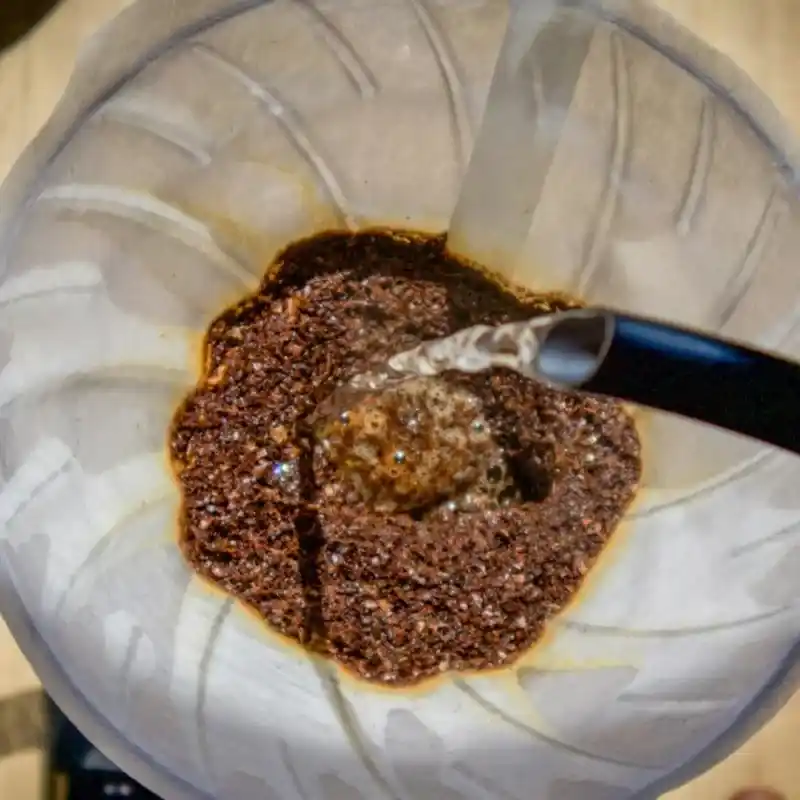
In the world of specialty coffee, water control is a mandatory standard. According to the recommendations of the Specialty Coffee Association, the mineralization rate of water for brewing coffee is 75-250 ppm.
For espresso, it’s not just the total number that matters, but the balance of calcium and magnesium. Water that is too purified makes the taste flat, while water that is too mineralized offsets the acidity and complicates the flavor.
You can improve the water quality of your coffee maker by using reverse osmosis filter cartridges with remineralization or special mineral mixtures.
Practical advice from an expert
When choosing a TDS meter, focus on the task at hand: a basic model with automatic temperature compensation is sufficient for home use. For a coffee shop, it is better to invest in a professional device with calibration capabilities. Regular calibration is the key to reliability.
The calibration solution should be periodically renewed and the electrodes rinsed with distilled water after each use.
And the main thing is to remember that TDS is an indicator that shows the concentration of dissolved substances, not their quality.