Key theses
- Pre-wetting is the controlled degassing of CO2 from the coffee grind before the main extraction
- The process improves brewing uniformity and flavor quality
- The optimal ratio of water to coffee is 2:1 or 3:1 by weight
Pre-wetting (or brewing) is the initial stage of coffee brewing, when a small amount of hot water comes into contact with ground coffee for 15-45 seconds. This process is not just a fashion trend among coffee enthusiasts.
It has a serious scientific basis.
Freshly roasted coffee contains a significant amount of carbon dioxide (CO2), which is produced when the beans are roasted. When you pour hot water over the coffee grinder, the CO2 begins to actively release in the form of bubbles. This process is called degassing, and it’s the key to understanding the importance of pre-soaking.
Without proper pre-wetting, carbon dioxide creates barriers to even extraction. Gas bubbles can block the water from contacting the coffee particles, resulting in uneven brewing. The result. Coffee with an underdeveloped flavor profile and potential flavor defects.
Pre-moistening allows for controlled removal of excess CO2, preparing the coffee grind for optimal extraction of aromatics and oils.
The scientific basis of the prewetting process
Understanding the science behind pre-roasting begins with the chemistry of coffee roasting. The heat treatment of the beans produces carbon dioxide as a byproduct of the Maillard and caramelization reactions. This gas remains “locked” in the cellular structure inside the coffee bean.
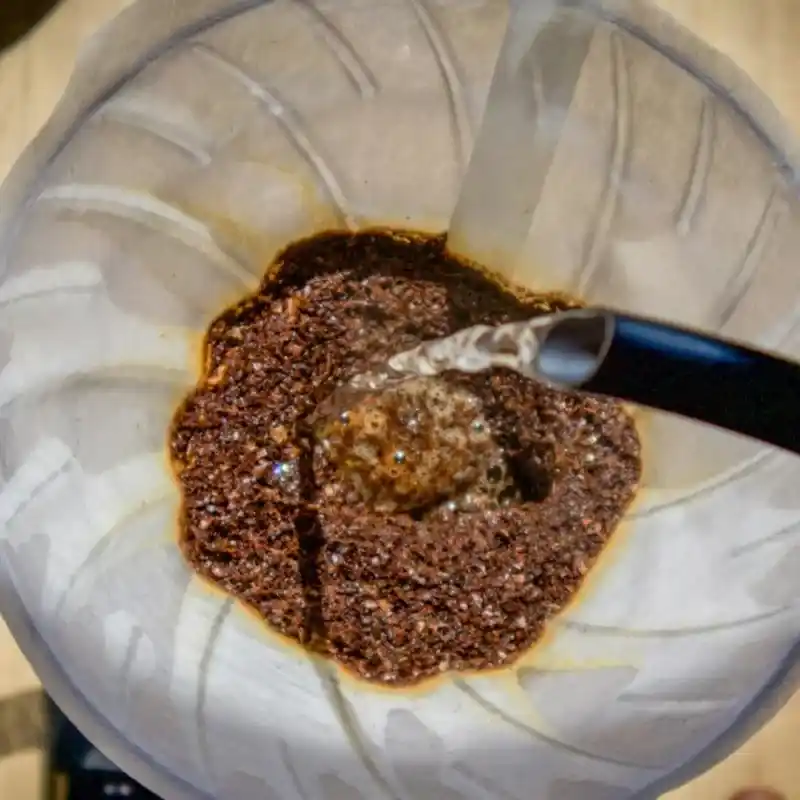
When hot water (optimum temperature 90-96°C) comes into contact with the ground coffee, it displaces carbon dioxide and the degassing process is accelerated. The CO2 is rapidly released, creating the characteristic “bloom” or “bloom” of the coffee grind.
This is why it is important for the quality of the extraction.
Carbon dioxide prevents water from penetrating the coffee particles evenly. Gas bubbles create microchannels and uneven water flow through the coffee layer. This results in under-extraction of some areas and over-extraction of others.
In addition, excess CO2 can form carbonic acid when it comes into contact with water. This weak acid adds unwanted acidity to coffee, masking the natural flavor characteristics of the beans.
Proper pre-wetting can remove up to 80% of the carbon dioxide from the coffee grind in a controlled manner. The water gradually penetrates the pores of the coffee particles, displacing the gas and preparing the material for uniform extraction of soluble substances.
Degassing and its role in coffee flavor
Degassing during the pre-wetting process directly affects the flavor profile of the finished coffee. When carbon dioxide remains in the coffee grind, it creates several problems for extraction.
First, excess CO2 creates carbonic acid. This substance adds a sharp, unpleasant acidity that masks the natural fruit and floral notes of coffee. The result is a drink with an unbalanced flavor.
Secondly, gas bubbles prevent the coffee particles from being evenly wetted. Some grinding areas receive insufficient water, while others receive excessive water. This leads to simultaneous under-extraction and over-extraction in different parts of the coffee layer.
Proper pre-moistening eliminates these problems:
- Cleaner acidity – removing CO2 prevents the formation of carbonic acid,
- Balanced taste – even extraction reveals the natural sweetness of coffee,
- Brighter aromatic notes – better access of water to aromatic oils.
After proper pre-soaking, the coffee demonstrates a clean, balanced taste with emphasized sweetness and reduced bitterness.
Factors affecting the prewetting process
The effectiveness of pre-wetting depends on several key variables that interact in a complex way.
Water temperature plays an important role in the rate of degassing. The optimal range of 90-96°C ensures active CO2 release without excessive tannin extraction. Lower temperatures slow down the process, while higher temperatures can lead to over-extraction.
The freshness of the coffee roast is directly correlated to the amount of carbon dioxide in the beans. Coffee roasted 2-14 days ago shows the most active degassing. Older coffee may require longer pre-soaking or more water.
The degree of grinding affects the surface area in contact with water. A finer grind increases the degassing rate but may result in excessive extraction. A coarser grind requires a longer time for complete degassing.
Water quality also matters. Soft water with a low mineral content allows for more efficient degassing. Hard water can slow down the process and affect the flavor.
Expert opinions on the effectiveness of pre-wetting
Leading coffee experts are unanimous in recognizing the importance of pre-wetting for extraction quality. James Hoffmann, author of The World Atlas of Coffee, emphasizes that proper pre-wetting can improve brew consistency by 15-20%.
Maxwell Colonna-Dashwood demonstrates in his research how pre-wetting affects extraction uniformity by reducing channel formation. His experiments show a significant improvement in flavor balance when using controlled degassing.
Scott Rao, a well-known roasting and brewing consultant, recommends adapting the pre-wetting parameters to the specific characteristics of the coffee and brewing methods.

The optimal water to coffee ratio for pre-wetting
Determining the right amount of water for pre-wetting is a balance between effective degassing and preventing premature extraction. Too little water will not fully wet the grind. Too much will result in a loss of process control.
For filter methods (pourover, V60), the optimal ratio of water to coffee during the pre-wetting process is 1:2 to 1:4, e.g. 30-60 g of water per 15 g of coffee. This range ensures sufficient wetting without excessive dilution.
The experiments show interesting patterns:
A 2:1 ratio (30 g of water to 15 g of coffee) ensures minimal but effective wetting. This option is suitable for very fresh coffee with active degassing. Advantages: controllability, minimal premature extraction. Disadvantages: uneven wetting of coarse grinds is possible.
The 3:1 ratio (45 g of water to 15 g of coffee) is the most versatile option. Provides complete wetting of most types of grinds while maintaining control over the process. Recommended for daily use.
A ratio of 4:1 (60 g of water to 15 g of coffee) is suitable for older coffee or very coarse grinds. The increased amount of water compensates for the reduced degassing. Risk: Possible premature extraction of bitter substances.
It is important to remember that these proportions may need to be adjusted depending on the specific characteristics of the coffee and personal taste preferences.
Experimental analysis of the effect of water volume on filtration and extraction
Controlled experiments show a direct correlation between the volume of pre-wetting water and the filtration rate. More water results in a faster initial passage through the filter, but can slow down the overall brewing time due to swelling of the coffee particles.
TDS (total dissolved solids) measurements show that the optimal ratio of 3:1 provides the most stable extraction with minimal fluctuations between different brews.
The right pre-moistening technique
Excellence in pre-moistening is achieved through precision and understanding of each step of the process. Here is a step-by-step algorithm for optimal results:
Equipment preparation – warm the funnel and cup with hot water (90-96°C). Rinse the paper filter to remove the taste and ensure a better adhesion to the funnel walls.
Pouring coffee – place the coffee grinds in the filter, shake gently to distribute evenly. Create a small depression in the center to ensure even distribution of water.
Start of pre-wetting – start pouring water from the center, moving in a spiral outward. Pouring speed – slow and controlled to avoid channeling.
Volume control – use a scale to ensure the exact 2:1 or 3:1 ratio. For 15 g of coffee, pour 30-45 g of water for 10-15 seconds.
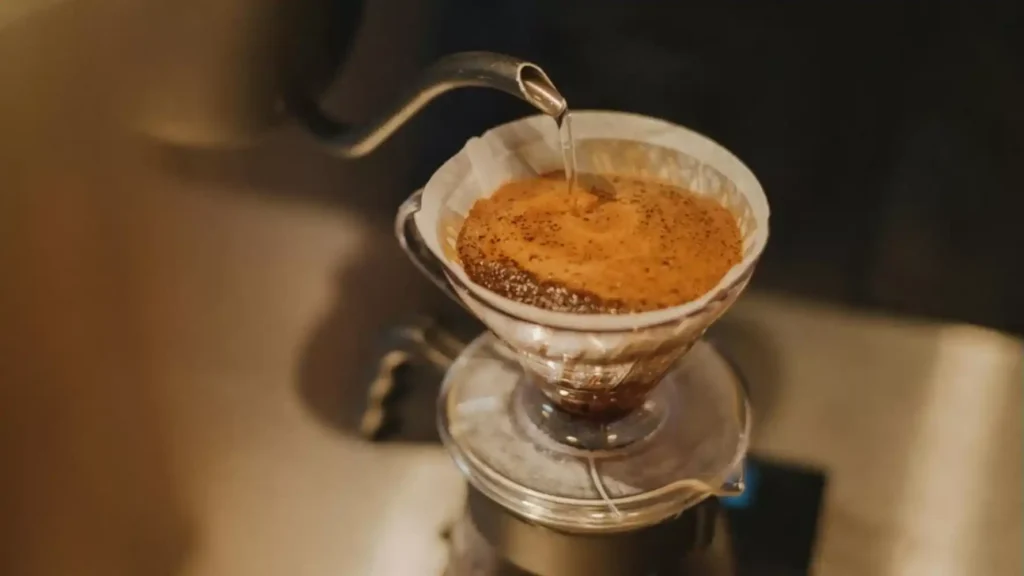
Observe degassing – fresh coffee will begin to “bloom”, increasing in volume and releasing CO2 bubbles. This process indicates proper degassing.
Waiting – Allow the coffee to degas for 15-45 seconds. The time depends on the freshness of the roast and the activity of the gas.
Continue brewing – after the pre-wetting is complete, continue pouring the rest of the water according to the selected method.
Key principles of successful pre-wetting:
- Uniform distribution of water over the entire grinding surface
- Controlled casting speed to prevent channeling
- Precise adherence to time intervals
- Observation of visual indicators of degassing
Properly performed pre-wetting reduces the risk of channeling, ensures even wetting and improves extraction quality. The result is coffee with a cleaner flavor and better balance.
Indicators of successful prewetting
Visual and aromatic indicators will help you assess the quality of the pre-moistening:
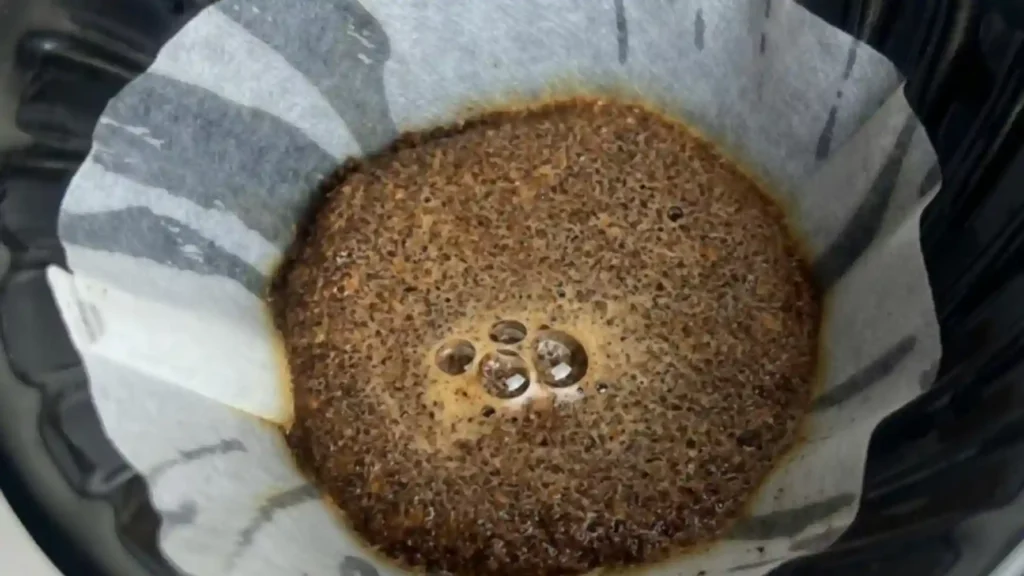
“Blooming” of coffee – the grind should increase in volume by 30-50%, creating a dome shape. This indicates the active release of carbon dioxide.
CO2 bubbles – foam with small gas bubbles should appear on the surface. The intensity depends on the freshness of the roast.
Aroma – during degassing, the release of aromatic substances is enhanced. Proper pre-soaking is accompanied by a bright coffee aroma.
How to determine the correct degassing during prewetting
Freshly roasted coffee (2-7 days) shows rapid degassing with active bubble formation. Coffee aged 1-2 weeks shows moderate “blooming”. Older coffee (more than a month old) may not respond to pre-wetting at all, indicating a loss of CO2.
Optimal degassing lasts 20-40 seconds with a gradual decrease in gas release activity.
The effect of pre-wetting on paper filter performance
Pre-wetting has several positive effects on the performance of the paper filter. Pre-moistening ensures that the filter adheres to the walls for more even coffee distribution and warms the brewing vessel.
Proper pre-moistening reduces the risk of channeling, which is the formation of quick paths for water to travel through the coffee layer. Uniform initial wetting creates a homogeneous structure through which water passes at a constant speed.
In addition, pre-steeping affects the brewing time, yield and flavor profile of the finished beverage, in particular, it reduces acidity compared to coffee without pre-steeping.
How pre-wetting affects the final taste of coffee
Pre-soaking creates a fundamental change in the flavor profile of coffee through controlled degassing and improved extraction. Proper pre-wetting of freshly roasted ground coffee helps to degas CO2, stabilizes extraction, and improves flavor by reducing excessive acidity from carbonic acid.
Main flavor preferences:
Reduces unwanted acidity – removing excess carbon dioxide prevents the formation of carbonic acid, which creates a sharp, unpleasant acidity. The result is a cleaner, more balanced acidity.
Improved sweetness – uniform extraction allows for better extraction of natural sugars from the coffee beans. Coffee becomes sweeter without the addition of sweeteners.
Brighter aromatic notes – swelling of the grind allows better water access to the aromatic oils, revealing complex fruity, floral or nutty characteristics.
Reduced bitterness – controlled extraction prevents the over-extraction of tannins and other substances that create unpleasant bitterness.
Interestingly, pre-moistening whole beans before grinding (spraying ~20 microliters of water per gram) also improves the flavor. This method reduces static electricity, prevents particles from sticking together, improves extraction consistency, and results in a richer espresso flavor.
The overall effect of proper pre-soaking is a coffee with a cleaner, more balanced flavor, where the natural characteristics of the beans are fully revealed without being masked by extraction defects.
Pre-wetting for different brewing methods
Each brewing method requires adaptation of the pre-wetting technique to the specific equipment and extraction process. Understanding these differences allows you to optimize the result for any coffee brewing method.
Purover (V60, Hario ) is a classic method for demonstrating prewetting. Use a 3:1 ratio and a degassing time of 30-45 seconds. Pour water in slow circles from the center to the edges, avoiding contact with the filter walls.
Chemex – a larger volume requires a proportional increase in pre-wetting water. For 30 g of coffee, use 90-120 g of water. A thicker Chemex filter takes longer to fully wet.
AeroPress – unique design allows for pressure pre-moistening. Add the pre-moistening water, stir lightly and wait for degassing before adding the rest of the water.
French Press is an immersion method that requires a different approach. Add a small amount of water, wait for the “bloom”, then add the rest. Do not press the plunger until degassing is complete.
Pre-wetting when making espresso
In espresso, pre-wetting is realized through pre-infusion, which is the supply of water under reduced pressure before the main extraction. Preinfusion applies low pressure (1-4 bars) to evenly saturate the coffee beans, preventing channeling and promoting uniform extraction.
Modern espresso machines with pressure profiling allow you to precisely control this process: low pressure for pre-infusion, increasing to a peak (4.5-9 bars), and decreasing to prevent over-extraction.
Pre-wetting for alternative brewing methods
Cold Brew – Cold brew requires a longer pre-steeping time (2-3 minutes) due to the lower water temperature. Use room temperature for the initial steeping.
Siphon – the vacuum method requires pre-wetting at a lower temperature before the water is lifted into the upper flask.
Moka Pot – although pre-wetting is limited here, you can lightly wet the coffee grinds before assembling the coffee pot to improve extraction.

Experimentation and optimization of the pre-wetting process
Systematic experimentation is the key to perfection in pre-moistening. Each coffee is unique, and the optimal parameters may differ even for beans from the same farm.
Basic methodology of experiments:
Change only one parameter at a time, keeping the others constant. This will allow you to isolate the influence of a particular variable on the result.
Experiment 1: Pre-wetting time
Use the same amount of coffee (15 g), water (45 g for pre-wetting), and temperature (94°C). Vary the time: 15, 30, 45, 60 seconds. Evaluate the taste, aroma and visual differences.
Experiment 2: Water volume
Record the time (30 seconds), temperature (94°C), and coffee (15 g). Test the ratio of 2:1, 3:1, 4:1. Record filtration speed and flavor characteristics.
Experiment 3: Water temperature
Constants: time (30 seconds), volume (45 g), coffee (15 g). Vary the temperature: 88°C, 91°C, 94°C, 97°C. Pay attention to the intensity of degassing and flavor changes.
Evaluation of results:
- Keep a detailed log with parameters and results
- Use a TDS meter to objectively evaluate the extraction
- Conduct blind tastings to eliminate bias
- Repeat successful combinations to confirm results
Optimization is an iterative process. Start with the recommended settings, then gradually adapt them to your own taste preferences and the characteristics of your particular coffee.
Conclusions: how to integrate pre-soaking into your daily coffee practice
Pre-steeping is not just an extra step in brewing, but a fundamental technique that transforms the quality of your coffee. The scientific principles of carbon dioxide degassing and enhanced extraction make this process a must for anyone seeking excellence.
Start with the basic settings: 3:1 ratio, 94°C temperature, 30-45 seconds. These settings work for most coffees and brewing methods.
Gradually experiment with the parameters. Each coffee is unique – what works for an Ethiopian single origin may not work for a Brazilian blend.
Watch for visual indicators. Active “blooming” and the release of CO2 bubbles are your best guides to assessing the effectiveness of the process.
Key findings and tips for practical application
- Always use a scale to ensure that the proportions are exactly right
- Adapt the settings to the freshness of your coffee roast
- Keep a log of experiments to track improvements
- Do not neglect the pre-soak, even for a quick morning brew
- Remember: consistency is more important than complexity
Integrating pre-grinds into your daily routine doesn’t require a lot of time, but it dramatically improves your results. After a few weeks of regular practice, this technique will become a natural part of your coffee ritual.
Frequently asked questions
What is pre-wetting and why is it necessary?
Pre-wetting is the initial stage of brewing, when a small amount of hot water comes into contact with the coffee beans for 15-45 seconds. The process removes carbon dioxide from the coffee, improving the uniformity of extraction and flavor balance of the finished drink.
How much water is needed for pre-moistening?
The optimal ratio of water to coffee is 2:1 or 3:1 by weight. For 15 grams of coffee, use 30-45 grams of water. A larger amount is suitable for older or coarser coffee, and a smaller amount for freshly roasted coffee.
How does pre-wetting affect the taste of coffee?
Pre-moistening improves flavor by removing excess CO2, which prevents the formation of carbonic acid. The result is a cleaner acidity, better sweetness, brighter aroma notes and reduced bitterness. The coffee is more balanced and tastes better.
How long should the pre-moistening last?
The optimal pre-wetting time is 15-45 seconds depending on the freshness of the coffee. Freshly roasted coffee (2-7 days old) requires 30-45 seconds, older coffee may require up to 60 seconds to completely degas the carbon dioxide.
When should I use coffee pre-soak?
Pre-soaking is especially important for freshly roasted coffee (2-14 days after roasting), which contains a significant amount of CO2. For older coffee, the process is less critical, but still useful for improving extraction.
Is there a difference in pre-moistening for different types of coffee?
For example, different varieties and regions of origin may require adaptation of the pre-wetting parameters. Highland arabicas often have a denser structure and require a longer time, while African coffees may show more active degassing compared to Central American coffees.